Have you ever noticed how certain thoughts feel automatic and familiar?
You miss a deadline and the thought appears: “I’m terrible at managing time.”
You speak up in a meeting and later think: “I sounded stupid.”
You hesitate before applying for something and tell yourself: “I’m not ready.”
You don’t debate these sentences or analyze them because they feel like facts. But they are not facts. They are repetitions and repetition builds identity.
Most people think identity forms from big life events like a promotion, breakup, failure or success. In reality, identity forms quietly. It forms through small sentences repeated often enough that they stop feeling optional.
“I’m bad at confrontation.”
“I’m always late.”
“I’m not confident.”
“I’m too emotional.”
Say something often enough and it stops sounding like a description. It starts sounding like who you are. Your brain gets stronger at whatever you repeat. If you repeat a sentence regularly, it becomes familiar. Familiar becomes believable. Believable becomes automatic. Automatic becomes behavior.
That is the loop.
Sentence.
Belief.
Behavior.
Evidence.
Repeat.
If you tell yourself, “I’m awkward in social situations,” you will enter social situations expecting awkwardness. That expectation shapes your posture, your tone, your eye contact. If something small goes wrong, you treat it as confirmation. “See? I knew it.” The sentence strengthens.
It feels like proof. It is repetition.
The good news is the reverse is also true.
If you begin repeating, “I can handle uncomfortable moments,” your body enters situations differently. You stay present longer. You recover faster. Small mistakes feel less final. The sentence strengthens.
Identity is not just what happened to you. It is what you keep telling yourself about what happened.
Repetition Is Stronger Than Intensity
This is why casual self-criticism is not harmless. Saying “I’m such an idiot” after a small mistake might feel insignificant, especially if you say it jokingly. But repetition does not care about tone. It cares about frequency.
If “I’m bad at this” runs every time you struggle, your brain begins to treat struggle as proof of inadequacy instead of proof of learning.
And that changes behavior. It has the potential to make you try and risk less and avoid more. Then you gather more evidence.
Over time, the sentence becomes your personality and what I enourage you to do is start noticing which sentences you are strengthening without realizing it. Listen carefully to your self-talk for a day.
What repeats? Do you find yourself saying
“This is too hard.”
“I always mess up interviews.”
“I’m not disciplined.”
“People don’t really listen to me.”
These are identity builders and here is the important part: the brain does not require intensity to build identity. It requires repetition. You do not have to scream a sentence for it to take root. You just have to say it consistently. That is why small shifts matter and how I used them to change my self-talk and language and you can too.
Changing “I can’t handle this” to “This is challenging” does not feel life-changing in the moment. But repeated daily, it prevents identity collapse under pressure.
Changing “I’m terrible with money” to “I’m learning to manage money better” opens behavioral space. Learning invites effort. Terrible invites avoidance.
You become the sentences you repeat.
Not instantly but gradually.
States Versus Identity
Which is why awareness is so important.
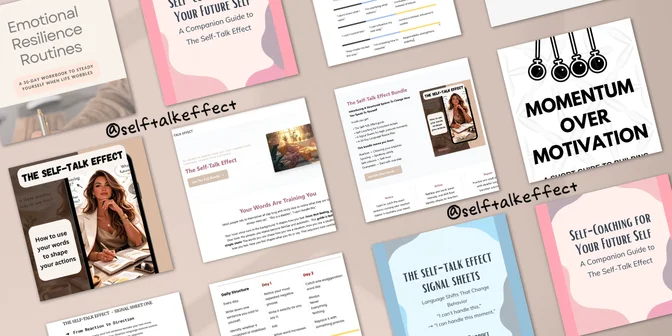
In The Self-Talk Effect guide, I explain how repetition turns language into behavior patterns. The goal here is consistency. If you want different outcomes, you have to examine the sentences that are building your identity underneath the surface.
There is a difference between “I struggle with consistency” and “I’m incapable of consistency.” One invites adjustment. The other shuts the door.
There is a difference between “I felt insecure in that moment” and “I am insecure.” One describes a state. The other defines a self.
States shift and definitions stick. If you repeatedly define yourself in limiting ways, you begin to behave in alignment with those definitions. If you repeatedly describe situations more accurately, you leave room for growth.
Think about the sentences you would never say out loud to someone you care about.
You would not tell your friend, “You always ruin everything.”
You would not tell her, “You’re just not cut out for this.”
You would not say, “This proves you’re a failure.”
Yet many women say those things to themselves weekly.
Identity does not argue back. It absorbs and then it acts accordingly.
Repetition Builds the Default
This is why repetition matters more than motivation. Motivation is inconsistent. Repetition is structural. It builds pathways, familiarity and default responses. If you repeat steadier sentences long enough, they begin to show up automatically.
Instead of “I can’t do this,” you begin to hear, “This will take effort.”
Instead of “I always mess this up,” you hear, “I need a better system.”
That shift seems subtle but it works. You do not need grand declarations, you just need consistent language.
Try this for one week.
Choose one identity-level sentence you tend to repeat. Something small but consistent.
Maybe it is “I’m bad with money.”
Maybe it is “I’m not confident.”
Maybe it is “I’m not disciplined.”
Rewrite it accurately.
“I’m learning how to manage money.”
“I’m practicing confidence.”
“I’m building discipline in small steps.”
Then repeat the new sentence deliberately over a set period of time and notice what changes in your behavior.
You will begin to act in alignment with the updated sentence. Because you become what you repeat. Not overnight. But inevitably.
A Quick Summary
Identity is not built from single events.
It is built from repeated sentences.
If you repeat limiting language, it becomes believable.
If it becomes believable, it becomes behavior.
If it becomes behavior, it becomes identity.
Repetition is stronger than intensity.
States shift. Definitions stick.
Small language changes, repeated daily, reshape behavior quietly.
And behavior, over time, reshapes who you become.
Your Next Step
Today, listen closely.
Catch one sentence that sounds like identity.
Ask yourself: Is this the version of me I want to keep building?
If not, adjust it. Repeat the adjustment daily.
Small sentences.
Repeated often.
Shape behavior quietly.
If you want a structured way to audit and replace the sentences building your identity, The Self-Talk Effect guide walks you through it step by step.
But for today, start here and notice what you repeat because you are becoming it.