Most people think change requires big moves like a dramatic realization or bold declaration, maybe even a complete personality shift. Well, I am here to tell you that it doesn't.
After nearly twenty years of working on my own personal growth I have come to understand that change happens in much smaller ways. One of those ways is through questions
Most change happens in the questions you ask yourself before you decide.
Every day, you make dozens of small decisions. What to say. What not to say. Whether to send the message. Whether to avoid the task. Whether to react immediately or pause. Most of these decisions feel automatic but they are rarely random. They are shaped by the questions running underneath.
The Questions Behind Your Decisions
You may not notice them, but questions are always present.
“Why does this always happen to me?”
“Why can’t I stay consistent?”
“What’s wrong with me?”
Questions like these narrow your focus. They direct your brain toward evidence of failure or frustration. Your mind searches for proof and, of course, it finds it.
Then decisions follow.
You withdraw.
You avoid.
You overreact.
Now change the question.
“What part of this can I handle?”
“What’s one small step forward?”
“What would steady look like here?”
The answers shift.
When the answers shift, behavior shifts. That is the mechanism. So you do not need more motivation, you need better questions.
Why Small Questions Work
Big questions overwhelm and often do little for us except cause anxiety and stress.
“How do I completely change my life?”
“How do I become confident?”
“How do I fix everything?”
Your brain does not know where to begin with these questions and it can be easy to feel overwhelmed.
Small questions are different.
“What needs attention right now?”
“What would help for the next ten minutes?”
“What’s the calmest response available?”
Small questions shrink the field and when the field shrinks, action becomes clearer. That clarity makes decisions easier because you are not trying to solve your entire future. Instead you are deciding the next move.
Before You React
Let’s make this real.
You feel irritated after a comment.
The automatic question might be:
“Why are they like this?”
That question fuels irritation.
Now try:
“What response aligns with who I want to be?”
That question fuels intention.
Or this.
You are procrastinating.
The automatic question:
“Why am I so lazy?”
That question builds shame.
Try instead:
“What’s one action I can take now?”
That question builds movement.
Small question. Better decision.
Repeat.
The Compounding Effect
The power here is not in asking one good question once. It is in repetition.
If you consistently ask, “What’s one steady choice here?” your decisions begin to reflect steadiness.
If you consistently ask, “What’s the next small step?” you begin to move forward more often.
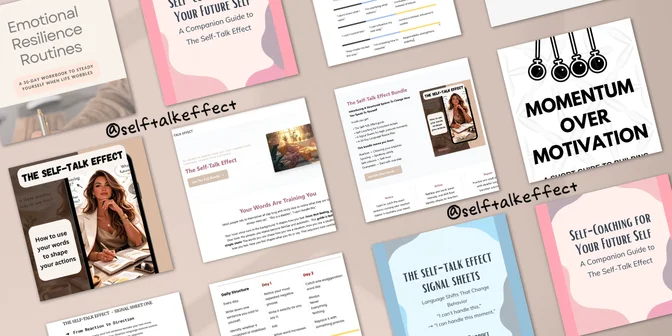
Identity shifts quietly through repetition. The Self-Talk Effect guide goes deeper into this repetition loop because it is not the size of the question that matters most. It is the consistency. Ask better questions daily, and better decisions become familiar. Familiar becomes automatic and automatic becomes identity.
Catching The Moment
This is not about interrogating yourself constantly or overanalyzing every choice. It is about catching the moment before reaction hardens into action. That moment exists more often than you think.
Right before you send the defensive reply.
Right before you scroll instead of starting.
Right before you say yes when you mean no.
There is usually a half-second gap and a question fits inside that gap.
Examples You Can Use Today
Instead of: “Why does this always happen?”
Try: “What is actually happening?”
Instead of: “What’s wrong with me?”
Try: “What needs adjustment?”
Instead of: “Why can’t I do this?”
Try: “What would make this easier?”
Instead of: “How do I fix everything?”
Try: “What matters most right now?”
Each shift narrows the focus and a narrow focus improves the decisions being made. Improved decisions build evidence of capability and that evidence becomes confidence. Confidence reduces reactivity and the cycle strengthens in your favor.
Decision by Decision
You do not become calm overnight or disciplined in one dramatic move. You become steady through repeated small decisions. Each one is shaped by the question you ask beforehand. This is why the phrase matters:
Small questions. Better decisions. Repeat.
It is not flashy but it is practical and it respect reality. Of course you will still have off days, we are human after all, you will still feel irritated sometimes but the question gives you direction. Direction is more useful than intensity.
A Quick Summary
Big change is built from small decisions.
Small decisions are shaped by questions.
If your questions are exaggerated or critical, your decisions will reflect that.
If your questions are steady and specific, your decisions improve.
Improved decisions repeated consistently reshape identity.
Small questions create better decisions. Better decisions repeated build momentum.
Your Next Step
Today, choose one question to practice.
Maybe: “What’s the next small step?”
Or:
“What response would I respect later?”
Keep it simple.
Use it once.
Then again tomorrow.
Small questions.
Better decisions.
Repeat.
If you want a structured framework that helps you build this into a daily habit, The Self-Talk Effect Bundle walks you through the process step by step.
But you do not need the entire system to begin you need one better question. Ask it before you react and then repeat.