Have you ever noticed how quickly a small situation can turn into something much bigger inside your head?
It rarely starts dramatically. A message feels off. A conversation replays in your mind. A task feels heavier than it should. You feel a slight shift in your mood, and then the thinking begins to speed up.
Within minutes, you are not just thinking about the situation. You are building a story around it. The story grows. The language intensifies. Your body follows.
That is a spiral.
Spirals are not usually caused by major events. They are built sentence by sentence. The first sentence might be small, but if it goes unchecked, it expands. “This is annoying” becomes “This always happens.” “I made a mistake” becomes “I always mess things up.” “This is uncomfortable” becomes “I can’t handle this.”
The escalation happens in the wording and if spirals are built with language, they can be interrupted with language.
Here is the fun part.
You do not need a lecture to interrupt a spiral or a perfectly crafted affirmation that sounds like it belongs on a wall. You need something short enough to grab in the moment.
That is where six words come in.
Six words are our fun way of doing it. That’s all. It is not a rule. It is not magic. It is simply a container. Six words are long enough to carry meaning and short enough to remember when your thinking starts racing.
When you are spiraling, your brain narrows. It wants certainty. It wants drama. It wants conclusions. Long explanations do not work well in that state because you will not access them. Short language works better because it fits inside the pressure.
But here is the important part.
This is meant to be playful.
Think of it like a secret handshake with yourself.
It is something you say internally that interrupts the pattern and makes you pause. It might make you smile slightly, or feel grounding. It might feel sharp and steady. The point is that it is yours.
Six words just happen to be a useful size.
You can use three words.
You can use four words.
You can use seven.
Better to have a ten-word interruption that you actually remember than a four-word one that sounds clever but never shows up when you need it.
Short works better because your brain can hold it under stress. That is the practical reason. When emotion rises, memory shrinks. A tight phrase is easier to access. But ultimately, it is your choice. The only real requirement is this: you must remember it when the spiral begins.
This is not about being rigid. It is about being ready.
Think of your interrupt phrase as something you keep in your pocket. When the spiral starts to spin, you reach for it.
Let’s make this concrete.
Different spirals have different emotional flavors. Embarrassment feels different from anger. Overthinking feels different from imposter syndrome. So your interrupt phrase should match the mood.
Here are six six-word stories you can use as starting points. Notice they are not stiff. They feel human.
Embarrassment
Everyone survives awkward moments like this.
That sentence reminds you that the moment is not unique. You are not alone in it. Awkward is part of being human.
Shame
One mistake does not define me.
Shame attacks identity. This sentence protects it. It separates behavior from who you are.
Overthinking
This thought does not need replaying.
Overthinking thrives on repetition. This line interrupts the loop. It tells your brain the replay is optional.
Self-sabotage
Comfort now steals confidence later.
Self-sabotage often feels soothing in the short term. This phrase brings future awareness into the present moment.
Imposter syndrome
I am learning, not pretending here.
Imposter syndrome whispers that you are faking it. This phrase reframes growth as learning instead of fraud.
Anger
Pause. Heat fades. Choose response wisely.
Anger moves fast. This sentence slows it down without dismissing it.
Read those again. None of them are dramatic. None of them are preachy. They are small course corrections.
Now here is where the fun part begins.
Write your own.
Seriously.
If embarrassment is your common spiral, what would make you smile slightly while still grounding you? Maybe something like, “Well, that was very human.” That is five words. It still works.
If overthinking is your habit, maybe your line is, “Brain, we are done here.” Five words. Short. Personal. Memorable.
If anger rises quickly for you, maybe you say, “Remember to respond strong, not loud today.” Seven words. Clear direction.
Six words is simply our playful structure. It forces you to compress the interruption. Compression makes you choose your language carefully. And careful language changes emotion. But do not overthink the word count - your aim here is to interrupt your spiral before it takes over.
Think of it like this. When the spiral starts, your brain is building a story. Your interrupt phrase steps in and says, “We're not telling that story right now.” It does not deny reality. It redirects the narrative.
The reason this works is simple.
Spirals are fueled by repeated sentences. When you repeat a catastrophic sentence, emotion escalates. When you repeat a steadier sentence, emotion stabilizes.
You are replacing one loop with another. The shorter the loop, the easier it is to access. That is why six words work so well. They are small enough to repeat twice in your head without effort.
Try it. Pick one of the six-word lines above. Say it slowly. Notice how your breathing changes slightly. Notice how the sentence has rhythm. Rhythm matters. It steadies you.
Now imagine catching a spiral early. You feel the rise. Instead of letting the original sentence run unchecked, you insert your secret handshake.
Everyone survives awkward moments like this.
Or
I am learning, not pretending here.
It is subtle. But subtle is enough. You are not trying to eliminate emotion. You are trying to prevent escalation.
And here is the deeper truth. When you consistently interrupt spirals, you begin to trust yourself more. You know that even if your thinking speeds up, you have a way to slow it down. That trust builds quietly.
So yes, writing about spirals is not exactly cheerful. But building your own interrupt phrase can be fun. It can feel creative. It can feel like reclaiming authorship over your internal language.
Today, choose one mood you know well.
Embarrassment. Shame. Overthinking. Self-sabotage. Imposter syndrome. Anger.
Write one short line that interrupts it. Keep it short enough to remember, personal enough to resonate and steady enough to guide you.
Then test it. Next time the spiral begins, use your words to stop it in its tracks.
Using Humor or Sarcasm
Here is something you may not know that I should enlighten you about.
Spirals take themselves very seriously. They rely on intensity. They rely on urgency. They rely on dramatic language that feels final and absolute.
When you introduce gentle sarcasm or light humor, you disrupt that seriousness. You shrink the scale. A dry line like, “Relax, nobody’s writing your biography,” quietly pulls the situation back to proportion.
Humor does not dismiss your feelings. It changes your relationship to them. It creates psychological distance, and distance lowers emotional heat.
When you can lightly mock the exaggeration in your thinking, you step out of it. The spiral loses momentum because it cannot survive without intensity. It needs you to believe it completely.
Humor makes that belief wobble. And once it wobbles, you are back in control.
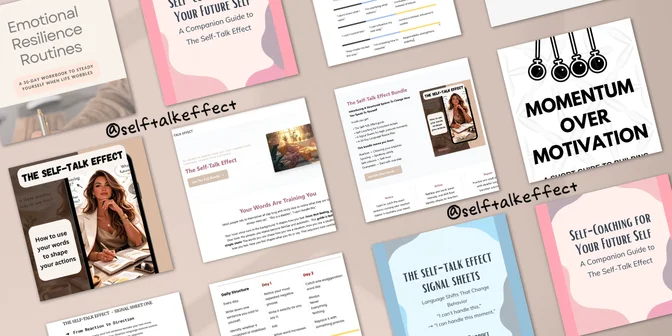
If you want more structured ways to practice interrupting spirals and building steadier language patterns, The Self-Talk Effect guide goes deeper into this system.
But for now, keep it simple.
Short phrase.
Small interruption.
Repeat when needed.
And yes, you are allowed to enjoy creating it.