Something I have come to understand in my two decades (where has that time gone!) of learning and working within personal development is that most people don’t need more advice.
They already know they should start.
They know they should finish.
They know scrolling won’t build their future.
They know avoidance feels worse later.
Knowledge is rarely the issue.
The issue is the sentence they say to themselves. The one that runs quietly in the background. The one that says
“It’s too late.”
“I’ll do it tomorrow.”
“I’m not ready.”
“This always happens.”
Those sentences don’t look dramatic. They look ordinary and that’s the problem. Ordinary language builds ordinary patterns and ordinary patterns repeated long enough become our identity. Put another way, if you tell yourself you are clumsy enough times you eventually believe it. Being clumsy just becomes part of who you are and that's just not right in my book.
The Self-Talk Effect exists because your words and steering you even when you're not paying attention.
You’ve probably heard the phrase, "Be careful what you tell yourself, because you are listening" - well its true and it is powerful. Our inner dialogue has the power to stop us in our tracks without us even knowing it happens. We just think its "the way things are" It sounds simple, but it’s powerful. Your inner dialogue can stop you in your tracks without you even noticing. You assume it’s just the way things are. It isn’t. It’s the effect of your own words.
You don’t act first. You explain it to yourself first. And that internal voice or self-talk sets the tone for everything that follows.
Psychologist Albert Ellis, one of the founders of cognitive behavioural therapy, argued that it isn’t events that disturb us but our beliefs about them. In plain English: what you tell yourself about what just happened determines how you feel next.
It’s not the event. It’s what you tell yourself about the event. It’s the meaning you give it.
The Self-Talk Effect helps you notice that meaning. Once you can hear the sentence clearly, you can question it. And once you question it, you can choose something steadier.
Why It Can Feel Hard to See
Here’s the tricky part. Your inner dialogue feels like you. It doesn’t feel like something you can edit. It feels like truth.
When you say, “I’m terrible at this,” it doesn’t feel like commentary. It feels like fact.
When you say, “I can’t handle this,” it feels accurate because in that moment, it feels real.
But language does something to your experience that you may not know. It exaggerates. It generalises. It labels. It predicts. That isn't a flaw;Your brain is trying to simplify a complicated world. The problem starts when those quick shortcuts become permanent conclusions.
If you repeat, “I always quit,” your nervous system starts preparing for quitting. If you repeat, “This is overwhelming,” your body responds with scale-based stress.
And here’s something mildly uncomfortable but useful: your brain believes what you repeat.
Think the same thought often enough and it starts to feel automatic. When it feels automatic, you act on it without noticing. That’s how patterns are built.
So no, it isn’t “just a thought.”
It’s practice.
The Self-Talk Effect exists because many people are practising the wrong script and then wondering why they keep getting the same result.
How Questions Play A Part
I decided to write The Self-Talk Effect because I believe a small question can do more than a long lecture.
“What am I telling myself right now?”
That question alone can shift how you feel in the moment. Questions reopen what you believe to be true. They invite curisoity and support development. Whereas what we usually do is make negative assumptions and statements about ourselves - doing that closes down any opportunity to reflect and look deeper.
Questions reopen thinking. They create space. They invite curiosity. Statements, especially negative ones, tend to shut things down. “This is a disaster.” closes us down compared to “This needs adjustment.” which opens an opportunity to explore further.
It is the same situation with two different outlooks. It provides two different emotional responses and will result in two different behaviors. That is the effect.
How The Self Talk Effect Works
The Self-Talk Effect is grounded in three core themes:
**Awareness. Replacement. Repetition.**
First, you notice the sentence before it runs you. In training terms, this is moving from not knowing to knowing. You start catching yourself in real time. You realise what you’ve been saying without noticing.
Second, you replace one word or a phrase or you choose something different. For example “I’m terrible at this.” becomes “This needs practice.”
Instead of: “I have to.” You say: “I choose to.” and “I’m stuck.” becomes “I need to adjust.”
Third, you repeat the steadier version until it feels natural. At first, you’ll catch yourself saying the old phrase. Then you’ll correct it. Eventually, the new sentence becomes your default.
This works because when something feels like your choice, you’re more likely to follow through.
Everyday Examples
Let’s keep this ordinary.
It’s Saturday. You want to watch something. You also said you would finish something important.
Your inner voice says: “I can't be bothered with this right now, I want to watch TV.”
That sentence is doing more than you think.
It makes it feel less important. And when it feels less important, you stop moving. It tells your brain, “No rush.” And your brain happily agrees. You have given yourself permission to let it slide.
Now replace it with:
“One small action still counts. Just work on it for 15 minutes.”
That feels manageable. It feels specific. And often, once you start, 15 minutes turns into more.
Here's another example. You wake up and think: “I have too much to do.”
Your body tightens. Your mind scans everything at once. You feel "stressed out"
Instead of going with what really could be a fact (you do have a lot to do) you decide to replace that phrase with a question and you ask yourself:
“What’s the next step?”
Suddenly what felt overwhelming feels lighter. The whole day shrinks into one action. Complete that. Then move to the next. Focusing on one step at a time makes consistency possible.
A Quick Reminder
The Self-Talk Effect exists because what you say comes before what you do.
When you understand that, you realise you can adjust what you say so it supports what you want to do. So, you act after you speak to yourself and small shifts in how you speak change what you do. If you keep repeating those small shifts they build into consistent results.
Most people are repeating a sentence that keeps slowing them down.
You’re already talking to yourself all day.
The only real question is: is that voice helping you move, or helping you stay stuck?
All it takes from you is a willingness to become more deliberate with the words that shape what you say and do - or don't say and do in some cases.
Your Next Step
Today, listen to your internal dialogue and catch one sentence. Then ask yourself: Is this sentence pushing me forward or holding me still?
If you choose to change it then repeat the steadier version twice. Then act once.
Small questions. Better decisions. Act. Repeat.
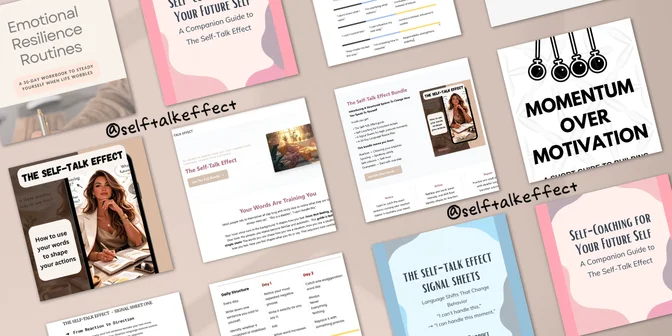
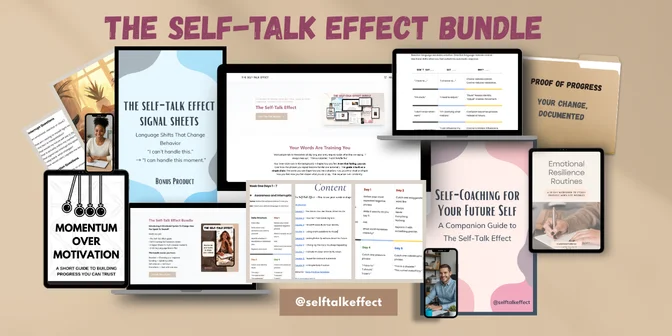
That’s where this begins and if you want to go deeper into the process, the full Self-Talk Effect Guide walks you through it step by step.